Low Water Pressure in the Whole House? 7 Checks Before You Call a Plumber
Disclosure: We may earn a commission when you buy through links on our site, at no extra cost to you.
When one faucet is weak, it’s that faucet. When every faucet, shower and hose in the house is weak, the problem is upstream. Somewhere between the street and your fixtures, something’s choking the flow.
Here are the checks I’d run in order. Most take five minutes and no tools you don’t already own.
Quick Picks at a Glance
| Product | Best For | Deal |
|---|---|---|
| Water Pressure Gauge | Measuring real PSI | Check Price on Amazon |
| Pressure Reducing Valve (PRV) | Replacing a failed regulator | Check Price on Amazon |
| Whole-House Filter Cartridges | Clogged filters | Check Price on Amazon |
| Faucet Aerator Kit | Clogged aerators | Check Price on Amazon |
| Smart Water Leak Detector | Finding hidden leaks | Check Price on Amazon |
Check 1: Measure the Pressure
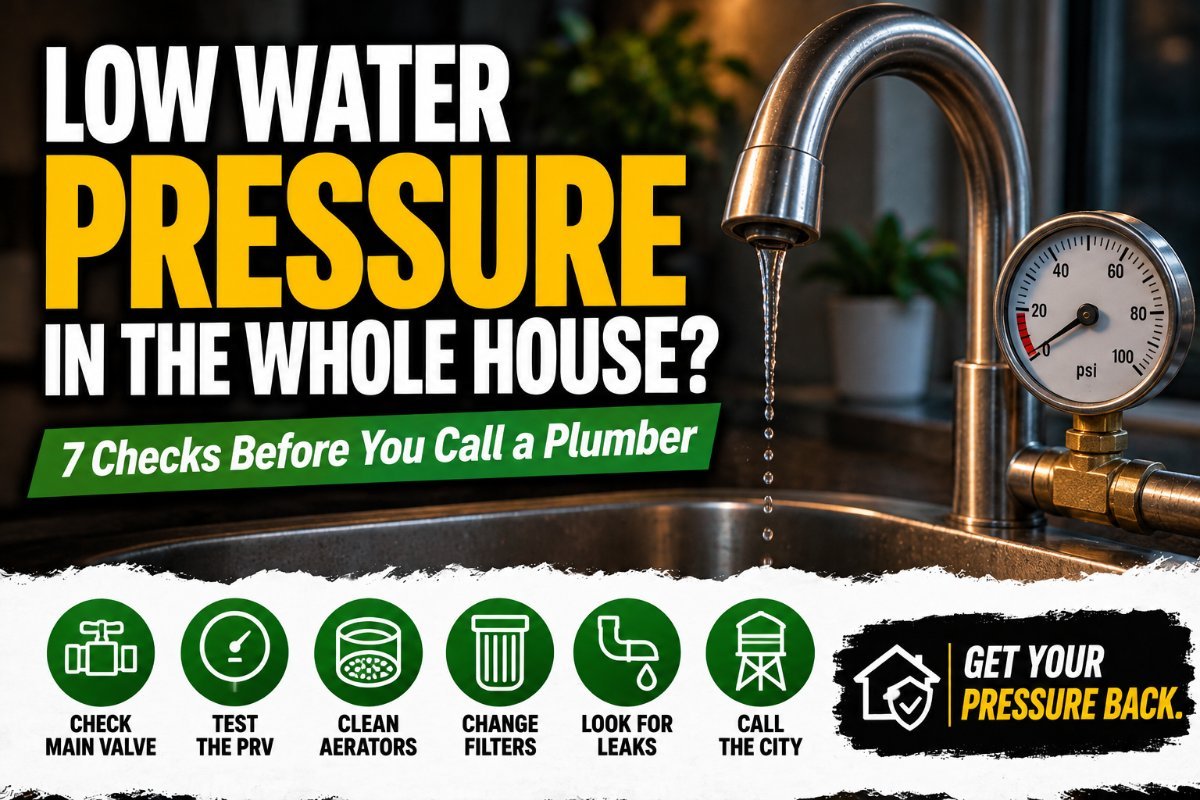
Screw a cheap pressure gauge onto an outdoor hose spigot and open it all the way. Normal home pressure runs about 40 to 60 PSI. Under 40 feels weak. Knowing the number tells you whether the problem is low supply or something inside the house.
Check 2: Make Sure the Main Valve Is Fully Open
It sounds too simple, but it happens a lot after plumbing work. Find your main shutoff (often where the water line enters the house) and make sure it’s fully open. Gate valves turn counterclockwise all the way. Lever valves should be parallel to the pipe.
Check 3: Test the Pressure Reducing Valve
Many homes have a bell-shaped regulator near the main shutoff. When it fails, pressure drops (or spikes). Some have an adjustment screw. If adjusting doesn’t help and your gauge reads low, the valve may need replacing. That’s a moderate DIY job or a quick plumber visit.
Check 4: Change Whole-House Filters
If you have a whole-house filter or softener, a clogged cartridge can strangle the flow. Swap the cartridge and test again. People forget about these for years.
Check 5: Look for Leaks
Turn off every faucet and appliance, then watch your water meter for 15 minutes. If it moves, water is going somewhere. A leak sensor kit helps you find the spot.
Check 6: Clean Aerators and Shower Heads
If the problem is mostly at certain faucets, unscrew the aerators and soak them in vinegar. Hard water clogs them fast.
Check 7: Ask Your Neighbors and Your Water Utility
If neighbors have low pressure too, the problem is the city’s, not yours. Utilities sometimes do main work or have pressure issues they’ll fix for free.
When It’s Bigger: Old Pipes
Galvanized steel pipes rust from the inside and narrow over decades. If your home is older and pressure has been slowly getting worse for years, repiping may be the real fix. That’s a pro job, so get several quotes.
Keep Reading
7 Signs You Need a Water Softener · Best Smart Water Leak Detectors · Hot Water Runs Out Fast? · Best Shower Head Combos
FAQ
What is normal water pressure for a house?
About 40 to 60 PSI. Over 80 PSI can damage fixtures and appliances.
Why did my water pressure suddenly drop?
Common causes include a partly closed main valve, a failed pressure regulator, a clogged filter, a leak, or city water main work.
Can I fix low water pressure myself?
Often. Opening valves, changing filters, cleaning aerators and adjusting a regulator are all DIY-friendly.
How much does it cost to replace a pressure regulator?
The part is affordable. Plumber installation costs more, depending on your area.
Do water softeners lower water pressure?
A properly sized softener shouldn’t noticeably. A clogged or undersized one can.