
7 Signs You Need a Water Softener (And When a Filter Is Enough)
Heads up: this post contains affiliate links. If you buy through them, Home Addressed may earn a commission at no extra cost to you.
You scrub the shower glass on Saturday. By Wednesday it’s cloudy again. Your new showerhead sputters like it’s 20 years old, and your hands feel weirdly sticky after you wash them. None of that is bad luck. It’s your water.
Hard water is just water carrying a lot of dissolved calcium and magnesium. It won’t hurt you to drink it, but it’s brutal on everything it touches in your house: pipes, fixtures, glass, laundry, and especially your water heater. The good news? You can usually diagnose it yourself in an afternoon for under $15.
Here are the seven signs I’d look for, plus the one test that settles it.
1. White crust on faucets and showerheads
That chalky white or greenish ring around your faucet base is limescale. It’s mineral left behind when hard water evaporates. A little after a long vacation is normal. If it comes back within days of cleaning, you’ve got hard water, period.
Check the little holes in your showerhead too. If some nozzles spray sideways or don’t spray at all, scale is plugging them. In the big Battelle study on softened water (commissioned by the Water Quality Research Foundation in 2009), showerheads running on hard water lost 75% of their flow rate in less than 18 months. That’s why a fancy rain head can feel like a garden mister after a year. We covered the best options in our shower head combo guide, but honestly, no showerhead survives hard water forever.
2. Spots and film on “clean” dishes
Glasses come out of the dishwasher looking foggy. Silverware has dried water spots. You’ve switched detergents twice and added rinse aid, and it’s still happening.
Minerals in hard water bond with soap and leave a film behind. Your dishwasher isn’t broken. It’s fighting chemistry it can’t win.
3. Soap that won’t lather
Hard water and soap don’t get along. The calcium and magnesium react with soap to form soap scum (that gray ring in the tub), so you need way more shampoo, body wash, and laundry detergent to get the same suds. If you’ve ever stayed at a hotel or a friend’s house and been shocked at how fast the soap foamed up, you were probably showering in soft water for the first time in a while.
4. Dry skin, dull hair, and stiff towels
That leftover soap scum doesn’t just stay on your tub. It sticks to your skin and hair too, which is why hard water can leave you itchy and your hair flat or straw-like. Towels come out of the dryer scratchy no matter how much fabric softener you throw in. Dark clothes fade faster and whites go a little dingy.
This one’s easy to blame on other things (weather, age, cheap towels), so I wouldn’t rely on it alone. Paired with signs 1 through 3, though, it’s a strong clue.
5. Your water heater is loud, slow, or dying early
This is the expensive one, and it’s the sign most people miss.
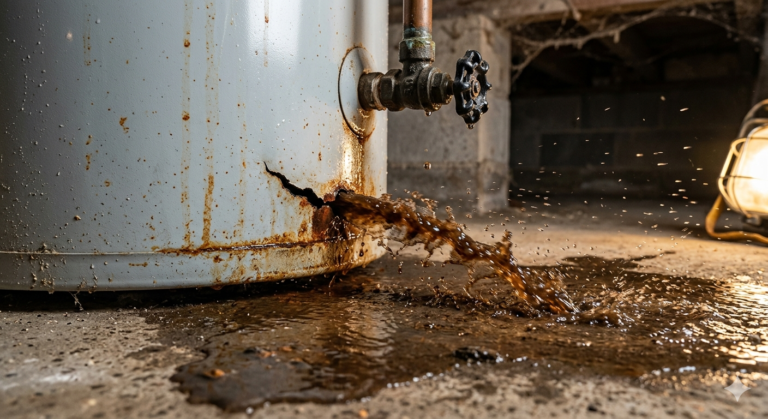
When hard water gets heated, the minerals drop out and settle at the bottom of the tank as scale. That layer acts like insulation between the burner and the water, so your heater burns more energy to do the same job. You’ll hear it as popping, rumbling, or crackling when the heater kicks on. That’s water trapped under the scale, boiling its way out.
The numbers from that same Battelle study are rough. Every 5 grains per gallon of hardness cost a gas tank heater about 8% in efficiency, and on very hard water the loss reached 48%. Electric heaters collected up to 30 pounds of rock-like scale over time. Tankless units fared worst of all: on 26 gpg water they stopped working entirely after the equivalent of just 1.6 years of use.
One fair caveat: the water treatment industry paid for that study. Still, anyone who’s drained a scaled-up tank has seen the gravel that comes out, and if your heater is already making noise, read our post on the warning signs your water heater is about to fail before it floods something.
6. Weak water pressure that keeps getting worse
Scale doesn’t only build up where you can see it. It coats the inside of pipes, valves, faucet aerators, and the inlet screens on your washing machine and fridge. Over years, that narrows everything. If pressure has slowly dropped across the whole house (not just one faucet), mineral buildup is a likely suspect, especially in older homes with galvanized steel pipe.
7. Appliances quitting before their time
Coffee makers that need descaling every month. A dishwasher that died at year six. An ice maker that clogs. A washing machine with a crusty inlet valve. Any appliance that heats or moves water takes a beating from scale, and replacing them early adds up to far more than most people realize.
The test that settles it
Symptoms point you in the right direction, but a number tells you what to buy. You’ve got two easy options.
First, look up your city’s annual water quality report. Every public water system has to publish one (it’s often called a Consumer Confidence Report), and most list hardness. Search “[your city] water quality report hardness.”
Second, buy hardness test strips. They cost around $10 to $15, take 30 seconds, and they’re the only option if you’re on a private well. You can grab a pack on Amazon here.
Results usually come in grains per gallon (gpg) or parts per million (ppm, the same as mg/L). One grain per gallon equals 17.1 ppm. Here’s how to read it, using the U.S. Geological Survey’s scale:
| Classification | Grains per gallon | ppm (mg/L) |
|---|---|---|
| Soft | 0 to 3.5 | 0 to 60 |
| Moderately hard | 3.5 to 7 | 61 to 120 |
| Hard | 7 to 10.5 | 121 to 180 |
| Very hard | Over 10.5 | Over 180 |
My rule of thumb: under 3.5 gpg, don’t bother. Between 3.5 and 7, it’s a judgment call based on how much the symptoms above annoy you. Over 7, I’d get a softener, because at that point you’re paying for hard water every month whether you see it or not.
Water softener or whole house filter? (They’re not the same thing)
This trips up a lot of people. A water softener removes hardness minerals (calcium and magnesium), usually through ion exchange with salt. It fixes scale, spots, and soap problems. It does almost nothing for chlorine taste, smell, or most contaminants.
A whole house filter does the opposite. It uses carbon and other media to pull out chlorine, chloramine, sediment, and certain chemicals. It makes water taste and smell better, but it won’t stop scale.
So which one do you need? If your problem is crusty faucets and a rumbling water heater, a softener. If it’s pool-smelling tap water, a filter. If it’s both (common on city water in hard-water regions like much of Texas, Arizona, and the Midwest), a combo system that filters first and softens second. Some homeowners also go salt-free with a “conditioner,” which doesn’t remove minerals but changes them so they’re less likely to stick. It’s lower maintenance, but in my opinion it’s not as effective on very hard water.
What I’d actually buy
For most homes on city water with hardness over 7 gpg, I like SpringWell’s filter and salt softener combo systems. They’re sized by bathrooms, they ship direct, and they handle both the scale and the chlorine taste in one setup. If you only need softening, their standalone salt-based softener costs less. If you hate hauling salt bags, look at their salt-free option, as long as your hardness isn’t extreme.
Whatever brand you pick, size it right. A softener’s capacity is measured in grains. Multiply your hardness (gpg) by the number of people in your house, then by about 75 gallons per person per day. That’s how many grains you remove daily. You want a unit that only needs to regenerate every week or so, not every night.
If you can’t install a whole house system right now (renters, I’m looking at you), a filtered showerhead and a vinegar soak for your fixtures every month will buy you some time. They won’t protect your water heater, though.
FAQ
How can I tell if I have hard water without a test kit?
Look for white crust on faucets that comes back within days of cleaning, cloudy spots on glasses straight out of the dishwasher, and soap that barely lathers. If you’ve got all three, you almost certainly have hard water. A $10 test strip or your city’s water report will tell you exactly how hard.
What hardness level needs a water softener?
Most water treatment pros recommend treatment once water goes over about 7 grains per gallon (120 ppm). Between 3.5 and 7 gpg is optional and depends on how much the symptoms bother you. Below 3.5 gpg counts as soft, so you don’t need one.
Is hard water bad for your health?
No. Calcium and magnesium are minerals your body uses, and hard water is safe to drink. The problems are cosmetic and mechanical: dry skin and hair, scale on fixtures, and shorter appliance life.
Does a water softener make water safe to drink?
A softener only removes hardness. It doesn’t remove lead, bacteria, PFAS, or most chemicals. If you’re worried about contaminants, you need a filter (whole house or under-sink) designed and certified for the specific contaminant.
Will a water softener fix low water pressure?
It stops scale from getting worse, and over time softened water can slowly loosen some existing buildup. But it won’t instantly clear pipes that are already badly scaled. You may still need to clean or replace aerators, showerheads, and in severe cases old galvanized pipe.
How long does a water softener last?
A decent salt-based softener typically lasts 10 to 15 years or more with basic care, like keeping salt in the brine tank and occasionally cleaning it. The resin inside wears out eventually, and chlorine in city water can shorten its life, which is one more reason combo systems with a carbon pre-filter make sense.
Disclosure: Home Addressed may earn a commission if you buy through links on this page, at no extra cost to you. See our affiliate disclosure.

3 Comments