
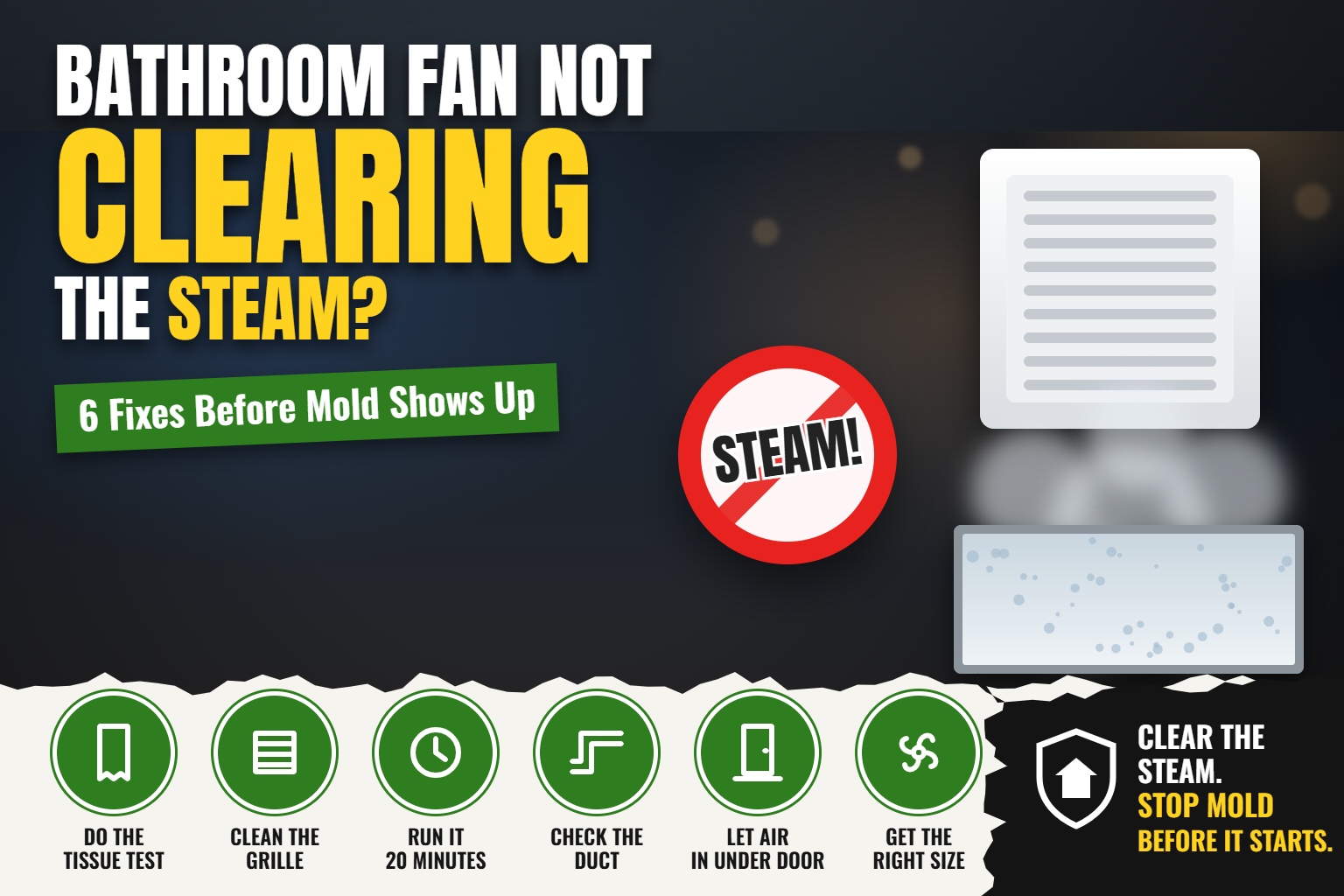
Bathroom Fan Not Clearing the Steam? 6 Fixes Before Mold Shows Up
Heads up: this post contains affiliate links. If you buy through them, Home Addressed may earn a commission at no extra cost to you.
You step out of the shower, the fan’s humming away, and the mirror’s still a white wall of fog 20 minutes later. Paint’s starting to bubble on the ceiling. There’s a gray-black line of mildew creeping along the caulk.
A bathroom fan that runs but doesn’t actually move air is weirdly common. Sometimes the fan’s too weak for the room. More often, something between the fan and the outside is choking it. Here’s how to figure out which, starting with a test that costs nothing.
1. Do the tissue test
Turn the fan on and hold a single square of toilet paper up to the grille. A working fan should suck it flat against the cover and hold it there. If the tissue just flutters, or falls, the fan’s barely pulling air.
While it’s running, go outside (or into the attic, if you can safely get there) and find where the fan vents out. You should feel air coming out and see the flap open. No air outside means the problem’s in the duct or the vent cap, not the fan.
2. Clean the grille and the fan
Bathroom fans suck in lint, dust, and hairspray all day, and that fuzzy gray coating on the grille cuts airflow a lot. Turn off the power at the switch (and the breaker if you’re going to touch the motor), pull the cover down, squeeze the spring clips, and wash the cover in the sink with dish soap.
Then vacuum the blower wheel and housing inside with a brush attachment. Run the tissue test again. A surprising number of “broken” fans come back to life right here.
3. Run it longer
This one’s a habit fix, not a hardware fix, and it matters more than most people think. The Home Ventilating Institute recommends running the fan for 20 minutes after you use the bathroom. Steam keeps coming off wet towels, walls, and the shower long after the water’s off. Most people shut the fan off on their way out the door, which leaves all that moisture behind.
The easy fix is a humidity-sensing fan switch or a countdown timer switch. A humidity switch turns the fan on automatically when the air gets steamy and shuts it off once it’s dry, so nobody has to remember. They replace a standard wall switch in about 20 minutes if you’re comfortable with basic wiring. If you’re not, any electrician can do it fast.
4. Check the duct
If the tissue test fails and the fan’s clean, look at the duct (only if you can safely get into the attic). Common problems: the duct came disconnected from the fan and is just dumping steam into the attic, it’s crushed or kinked, it sags in a long loop where water collects, or it’s way longer than it needs to be with lots of bends.
A fan that vents into the attic instead of outside is a real problem. All that moisture ends up on roof sheathing and insulation, which can lead to mold you won’t see until it’s expensive. Ducts should run as short and straight as possible to a proper exterior vent cap on the roof or wall, and the outside flap needs to swing open freely.
5. Let air in under the door
A fan can’t pull air out of a room if no air can get in. If your bathroom door seals tight against the floor or a thick rug, the fan’s working against a vacuum. HVI notes that bathroom doors need a gap at the bottom so replacement air can flow in. Leave the door cracked open while the fan runs, or check that there’s roughly a half-inch gap under the door.
6. Make sure the fan’s big enough
If the fan’s clean, the duct’s good, and it still can’t keep up, it’s probably undersized. Builders love cheap, weak fans. Fans are rated in CFM (cubic feet per minute), and HVI recommends 1 CFM per square foot of floor space for bathrooms up to 100 square feet. So an 8 by 10 bathroom needs at least 80 CFM. Bigger bathrooms get sized by fixtures, roughly 50 CFM each for a toilet, shower, and tub.
Look for the label inside the housing to see what you have. If it’s a 50 CFM fan in an 80 square foot room, there’s your answer. When you replace it, pick a quiet bathroom exhaust fan rated around 1.0 sone or less. Quiet fans get used. Loud ones get turned off.
Why this matters
Steam that hangs around doesn’t just fog the mirror. It peels paint, swells wood trim and vanity cabinets, and grows mold in grout and on the ceiling. And moisture from bathrooms adds to the humidity in the rest of the house, which is a big reason people get condensation on their windows in winter. A working fan protects more than just one room.
Ready to replace it? We rounded up the best quiet bathroom exhaust fans for every bathroom size and install situation.
FAQ
Why is my bathroom fan not removing steam?
The most common causes are a dirty grille and blower, a disconnected or crushed duct, a stuck exterior vent flap, a door that blocks makeup air, or a fan that’s too small for the room. A tissue test tells you quickly whether it’s moving air at all.
How long should I run my bathroom fan after a shower?
The Home Ventilating Institute recommends running it for 20 minutes after using the bathroom. A timer or humidity-sensing switch makes that automatic.
How do I know if my bathroom fan is working?
Hold a square of toilet paper up to the grille while it runs. It should get pulled flat and stay there. Then check outside where the fan vents to make sure air is coming out.
What size bathroom fan do I need?
For bathrooms up to 100 square feet, HVI recommends 1 CFM per square foot of floor area. Larger bathrooms are sized by fixtures, about 50 CFM each for a toilet, shower, and tub, and 100 CFM for a jetted tub.
Can a bathroom fan vent into the attic?
It shouldn’t. Venting into the attic dumps moisture onto insulation and roof sheathing, which can cause mold and rot. The duct should run to an exterior vent on the roof or wall.
Will a bathroom fan prevent mold?
A properly sized fan that runs long enough removes most of the moisture mold needs. Combine it with wiping down wet surfaces and fixing any leaks, and you’ll keep most mold from getting started.
Disclosure: Home Addressed may earn a commission if you buy through links on this page, at no extra cost to you. See our affiliate disclosure.


One Comment